SANT’ANDREA AL QUIRINALE, ROME
This model began life as an order from a London art collector who spent much of his time in Rome. He was fascinated by the work of Bernini, Borromini and other roman architects from the Baroque period. I, too, had visited Sant’Andrea al Quirinale when I was a teenager studying architectural history and it left a permanent impression on me. The request to build the model, therefore, arrived like manna from heaven, all the more so because, when my client died when the work was half-finished, this meant that I could complete the model at my leisure and then keep it for myself – which is what I did. Although I received an advance to cover the material costs, my fees were never paid. This turn of events, however unfortunate for my client, rather struck a chord with me because Bernini himself had waived his fee in return for a daily ration of bread, which mirrors more or less my own living conditions during this period.


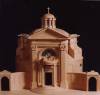
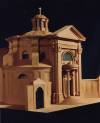
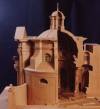
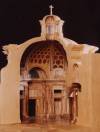


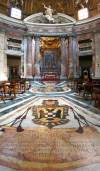
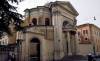
Bernini considered this church to be his most perfect design and he continued to go there to listen to Mass into his old age and right up to his death in 1680 at the age of 82. It is a design that broke new ground. The site itself was small with the street frontage much wider than the depth. Normally the interior is based on some sort of rectangular configuration, but Bernini broke with tradition. He created an oval plan, something that would have been unthinkable in Renaissance times, but, not only that, with the main axis of the oval leading from the entrance to the altar being the short one. This is a most definitely Baroque church; Borromini, his rival, had done something similar with San Carlo alle Quatro Fontane, begun fifteen years earlier. The entrance façade was the last element to be built and other elements, like the lantern, were improvised or modified during construction.
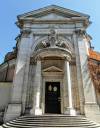
Bernini has used what is called the “giant order” of architecture, which means that the steps that lead up to the church and the porch and the whole body of the church itself are enclosed by a single giant pilaster each side that gives it a monumentality which makes you forget how relatively small it is. He also has the steps spilling out into the street like a series of ripples. Bernini loved creating visual movement in his architecture as well as hidden natural light sources.
The body of the present church was built in 1658–1661. Bernini designed it, but he left the actual work of construction to a brilliant committee of architects and artists among whom were Mattia de’ Rossi and Antonio Raggi. The reason the entrance façade was built last is that the pope, Alexander VII, wanted to hide it behind a screen wall. Wisely, they left the entrance arrangements unfinished and in limbo until the pope died. This left the road clear to build the façade that we see today which went up in 1670. The Papal requirement to hide the entrance behind a screen wall was forgotten and the whole edifice was finally finished and consecrated in 1678.
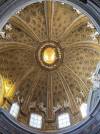
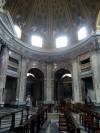
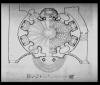
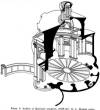
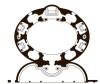
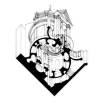
From the point of view of building the model, using original drawings for reference, one is immediately immersed in the technicality of measurement, dimension and number, geometry, volume and material, trying always to remain as faithful as possible to what the architect intended. I noticed that the proportional relationships, above all in the internal volume of the church, were very specific and these are not mentioned in anything I have read yet about this church. For example, the internal oval plan of the church measures 24m width x 17m deep, which is an exact ratio of 1:√2. The internal height from floor to the top of the vault is equal to the greater axis of the oval plan, namely 24m, meaning that one can inscribe a circle of that diameter perfectly into the section. The lower edge of the internal cornice is at exactly 12m, half way between floor and vault, while a rectangle inscribed from the top of the cornice to the 24m mark has a ratio of 1:√5. This, I am sure was intended and not just a coincidence. Since Antiquity, number and proportion have been considered indivisible and inseparable in architectural design, Chartres Cathedral being the best-known example. I remain undecided as to how to interpret this, but I am convinced that deep down the human mind and body subliminally finds a resonance in mathematical harmonies. I have marked up a plan and section with geometrical overlays to illustrate this point.


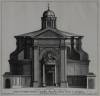
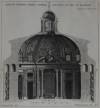
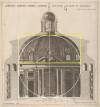
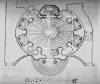
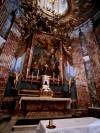
When churches built at this period were finished in marble, this was usually with a thin veneer to save cost; Sant’Andrea was different in that no expense was spared – the interior was built in solid Carrara marble. Its colour is a rather stern greyish-brown – some people call it prosciutto or hamburger meat – but the choice was intentional to represent what is stern down here on Earth. The only light and colour that penetrate into the church come through the stained glass high up and the lanterns which glow with a golden light, representing the Paradise above our heads. A second lantern, hidden from public view, illuminates the altar from above with this golden light. The altar itself is a painting of St Andrew being horribly crucified on a cross of St Andrew, framed in this same earth-coloured marble. Overhead, St Andrew is rising up to Paradise through a broken pediment, freed from his earthly suffering.
How St Andrew became the patron saint of Scotland and how the Cross was incorporated into the Scottish flag is another story, but, for the anecdote, I have to mention that my client for this model was both a Scot and called Andrew.