
THE FLYING MACHINE
« A bird is an instrument working according to a mathematical law. It lies within the power of man to make this instrument with all its motions, but without the full scope of its powers; but this limitation only applies with respect to balancing itself. Accordingly, we may say that such an instrument fabricated by man lacks nothing but the soul of man. »
None of Leonardo’s ambitions lay closer to the heart of his vision of man’s ability to create ‘a second world of nature’ than his desire to achieve man-powered flight. His ambition was to create a mechanical organism which would work in perfect concord with the physical laws of the universe to overcome the very elements themselves. He was also keenly aware of the challenge of the legendary inventors from the ancient world, including of course Daedalus for flight, and had no doubt that legendary status would be accorded to the first modern inventor who was successful in teaching man to fly: ‘the great bird will take its first flight on the back of the great Swan [i.e. from Monte Cecceri, near Fiesole] filling the universe with stupor, filling all writings with its fame and bringing eternal glory to the place of its birth. »
He also had no doubt as to where the solution lay. If he could arrive at a full understanding of how birds sustain themselves in the air, particularly mighty birds such as the eagle, he would be able to apply the acquired principles to the exigences of manned flight. He sought this understanding not only in detailed analysis of bird flight, recording with great subtlety the refined skill with which birds achieve balanced dynamism, but also through the science of the motions of air ‘which will be confirmed by means of the motion of water within itself, and by means of this visible science you will arrive at understanding’.
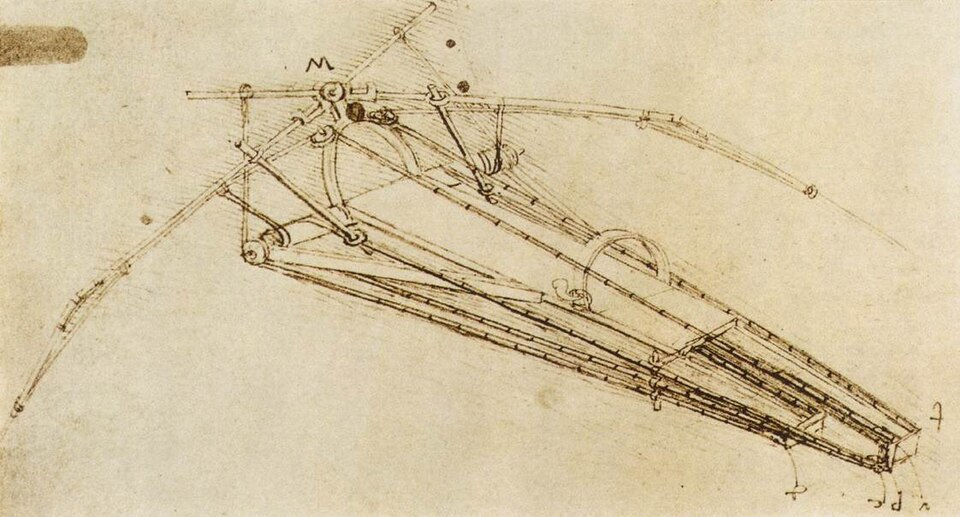
His first sustained assault on the problem of manned flight occurred in Ms.B in the late I480s, although there are signs of his interest in this question as early as c1478-80. He considered a number of systems, including a spiral ‘air-screw’ and a device in which a standing man operates four giant wings, somewhat like a monstrous dragonfly. The most coherent of his designs occur on folios 73-75r, and provide the basis for the present model. They show an overtly bird-like system, in which a man in a prone position operates two palmate wings, primarily through foot-pedals. None of the designs are wholly resolved, complete and unambiguous. Like so many of his sheets of mechanical studies, the notes and drawings constitute an unfinished debate about ways and means. This debate was to continue into the second major phase of his investigation of flight some fifteen years later.
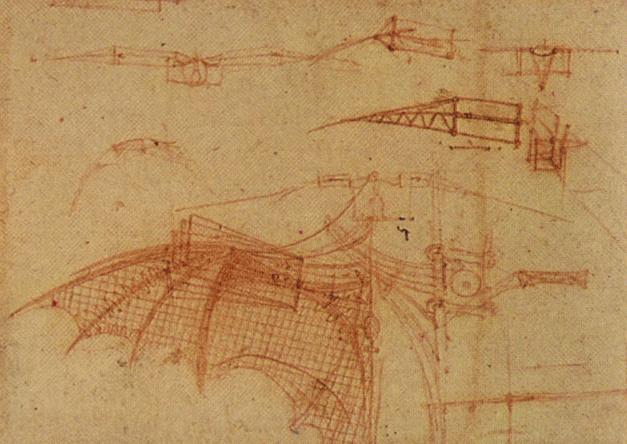
A small Codex in Turin, composed in I505, is largely devoted to perceptive analyses of bird flight in its own right, but his notes show that the idea of a flying machine was still very much in his mind. His more sophisticated grasp of the dynamics of bird flight and of the highly specialised anatomy of birds (no. I07) – with so much of the bird’s body-weight being assigned to the breast muscles – convinced him that a simple and direct emulation of flying creatures was not possible. Rather, man would have to re-apply the principle in keeping with his own limitations. Thus, he looked increasingly to systems of gliding in which the articulation of the wings was designed to orchestrate flight through subtle adjustments of angle and balance, rather than to provide the primary power. Again, a series of designs can be seen to be evolving with none apparently achieving definitive status.
Any attempt to construct ‘Leonardo’s flying machine’ therefore necessarily involves the designer and builder in an act of creative reconstruction rather than careful reproduction. To some extent the process is one of collage, pulling together compatible solutions from various pages of designs. But even this will not suffice since there are decisions to be taken by the designer who wishes to produce a fully working system, and unequivocal guidance for these decisions is not available in Leonardo’s surviving manuscripts, nor, probably, was it provided by his lost ones. The best the designer can do in these circumstances is to ensure that the decisions are compatible with Leonardo’s own technology and consistent with the style of his own inventive process.
In designing and building the present machine, for which a preliminary and a scale model were made, James Wink has worked from a large range of Leonardo’s drawing for bird-like and bat-like mechanisms, including detailed studies of components such as joints. Ms.B, 74V (fig. 62) provided the starting point, with the power amplified by the hand-turned windlass on f.75r, which also provided a general indication of the pulleys on vertical posts. The automatic flexing motion of the wing-tip was based on Ms.B, f.73v, which is also one of the folios on which the flap system is represented, while the system of upright rods in the wings required to provide sufficient angle for leverage was clarified through various drawings, including Codex Atlanticus f.22Vb/70r; (fig. 63) and Turin Codex, f11v. At the time of MS.B Leonardo was considering various hand-like wings, but the most satisfactory and workable wing-shape and articulated armature was found in later designs which used the wing motions for aerobatics rather than power (particularly Codex Atlanticus ff.309va/846v; fig. 65 and
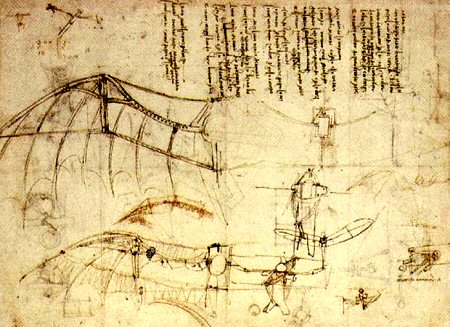
To achieve a functioning machine, a further series of choices were made of what seemed intuitively to be the best ways of achieving the desired results. As an example, we may look at one of the key problems which is unresolved in Leonardos surviving notes and diagrams. Leonardo was uncertain as to whether one pushing motion of one leg should correspond to a single downbeat of the wings or whether the pushing of both feet in succession should correspond to one downbeat, and whether the upbeat should be accomplished by a hand-driven windlass or by the motion of the feet – and so on. James Wink.’ s solution has been to use a form of crank integrated with a pulley – of a type consistent with Leonardos technology – to permit each pushing action to create both a downbeat and an upbeat, and to use the windlass to amplify the power.
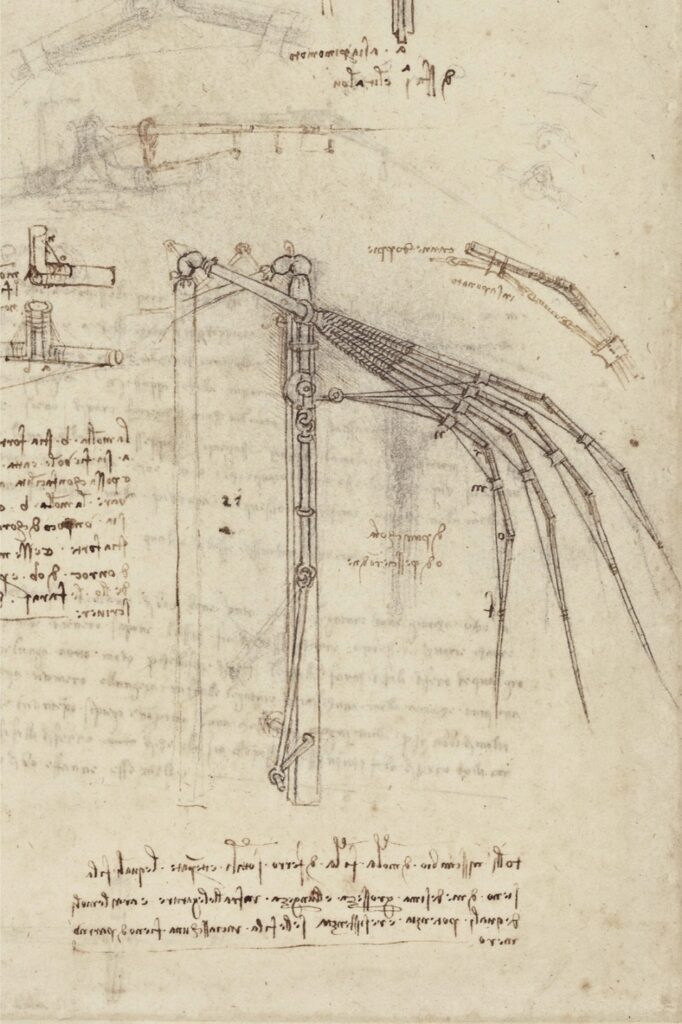
The building of the model has vividly illustrated the most intractable of all the problems faced by Leonardo or any aspiring aviator of his period, namely the lack of ultra-lightweight materials of high strength. Merely to support its own structure, the beech skeleton of the machine necessarily uses struts of quite considerable section. If we add Leonardo’s other ‘anatomical’ components, such as leather joints and thongs, springs of steel or cow-horn, and skin of starched taffeta, the weight becomes formidable. The present model weighs in at a massive 650lbs. This compares with just 72lbs for Daedalus 88, the man-powered aircraft with a 112ft wingspan which flew 74 miles over the Aegean Sea in April 1988. If, as seems likely, Leonardo did at least proceed as far as making test wings, he cannot but have become aware that he was far from any answer to the problem of achieving the necessary power-to-weight ratio for successful flight.
If the making of the model has underlined such difficulties, it has also confirmed the extraordinary potency of Leonardo’s vision. Using mechanical systems, the wings flap with much of the sinuous and menacing grace of a gigantic bird of prey. Though his ‘great bird’ was never destined to fill ‘the universe with stupor’ through taking flight, his designs retain their conceptual power as archetypal expressions of man’s desire to emulate the birds, and remain capable of inspiring a sense of wonder even in a modern audience, for whom the sight of tons of metal flying through the air has become a matter of routine.